Feed Your Brain in Full Color: The Science of Plant Pigments and Peak Mental Performance
Most of us reach for a cup of coffee when we need to think more clearly. Maybe a second one by 2 p.m. But what if the more lasting answer to brain fog, scattered focus, and that frustrating tip-of-the-tongue memory lapse wasn't in your mug — it was on your plate?
A growing body of neurological research is pointing to something genuinely exciting: the same pigments that give blueberries their deep indigo, sweet potatoes their sunset orange, and kale its dark, leafy green are crossing the blood-brain barrier and actively reshaping how our neurons communicate. This isn't wellness-influencer hype. This is biochemistry.
Let's break it down, color by color.
Why Your Brain Cares About Plant Color
Plant pigments aren't just decorative. They're chemical armor — compounds that plants produce to protect themselves from UV radiation, pathogens, and oxidative stress. When we eat those plants, we essentially inherit some of that protection.
The three pigment families getting the most attention in cognitive research are anthocyanins (the blue-purple-red family), carotenoids (yellows, oranges, and reds), and polyphenols (a broader class found across nearly every colorful plant food). Each of these can penetrate the blood-brain barrier — the highly selective membrane that guards your brain from harmful substances — and once inside, they get to work in ways scientists are still mapping out.
Here's the short version: they reduce neuroinflammation, boost blood flow to the brain, support the growth of new neurons (a process called neurogenesis), and help protect existing brain cells from the kind of oxidative damage that accumulates over years of modern life — stress, pollution, processed food, poor sleep.
In other words, eating colorfully isn't just good for your body. It's good for your mind.
The Blue-Purple Power: Anthocyanins and Memory
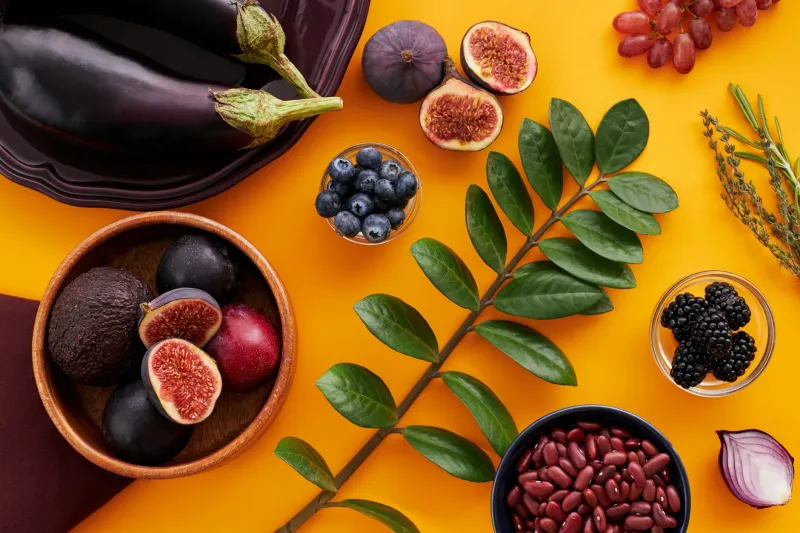
If you're going to start anywhere, start with blue and purple foods. Blueberries, blackberries, purple cabbage, Concord grapes, açaí — these are some of the most studied brain foods in nutritional neuroscience.
A landmark study out of Tufts University found that older adults who consumed blueberry supplementation over 12 weeks showed measurable improvements in memory and cognitive processing speed compared to a placebo group. A follow-up study from the University of Reading in the UK replicated similar findings in younger adults, suggesting these benefits aren't just about slowing age-related decline — they may enhance baseline cognitive function at any age.
The mechanism? Anthocyanins appear to increase signaling in the hippocampus, the brain region most associated with memory formation. They also improve cerebral blood flow, which means more oxygen and glucose reaching your neurons when you need them most.
Practical move: Add a handful of frozen wild blueberries to your morning smoothie. Wild varieties consistently show higher anthocyanin concentrations than cultivated ones, and frozen is just as nutritious as fresh — often more so, since they're frozen at peak ripeness.
Orange and Yellow: Carotenoids That Think Ahead
Carotenoids — the pigments in sweet potatoes, carrots, butternut squash, turmeric, and yellow bell peppers — are best known for supporting eye health. But their neurological résumé is getting longer.
Lutein and zeaxanthin, two carotenoids found in high concentrations in leafy greens and yellow-orange produce, have been linked in multiple studies to faster processing speed and better executive function. One study published in Nutritional Neuroscience found that higher lutein levels in the brain (measured post-mortem) correlated with better cognitive test performance during life, even after controlling for age and education.
Beta-carotene, the compound that makes carrots orange, is a precursor to vitamin A — a nutrient essential for maintaining the myelin sheaths that wrap around nerve fibers and allow signals to travel quickly between neurons. Think of myelin as the insulation on electrical wiring. When it degrades, signals slow down. When it's healthy, your thinking is sharper.
Practical move: Roast a sheet pan of orange and yellow vegetables — sweet potatoes, carrots, golden beets — with a drizzle of olive oil. Fat helps your body absorb fat-soluble carotenoids, so don't skip it.
Green: The Neuroprotective Powerhouse
Dark leafy greens are probably the most evidence-backed brain foods in existence, full stop. Spinach, kale, Swiss chard, arugula, collard greens — these are loaded with folate, vitamin K, lutein, and a range of polyphenols that collectively support cognitive longevity.
A Rush University study following over 900 older adults found that those who ate at least one serving of leafy greens per day had cognitive abilities equivalent to people 11 years younger than those who rarely ate greens. Eleven years. That's not a rounding error.
Folate, found abundantly in spinach and asparagus, supports the methylation cycle — a biochemical process involved in neurotransmitter production, including serotonin and dopamine. Without adequate folate, that process falters, and mood and focus can take the hit.
Practical move: Work greens into every meal, not just salads. Stir spinach into pasta sauce. Blend kale into a fruit smoothie (you won't taste it). Add arugula to pizza straight from the oven.
The Gut-Brain Connection: Why Diversity Is the Real Strategy
Here's where things get especially interesting. The brain doesn't operate in isolation from the rest of your body — and the gut-brain axis is one of the most actively researched areas in modern neuroscience.
Your gut microbiome — the trillions of bacteria, fungi, and other microorganisms living in your digestive tract — communicates constantly with your brain via the vagus nerve, influencing mood, stress response, and cognitive function. And what feeds a diverse, thriving microbiome? Plant diversity.
Research from the American Gut Project found that people who ate 30 or more different plant foods per week had significantly more diverse gut microbiomes than those who ate 10 or fewer. More diversity in the gut appears to correlate with better mood stability, lower anxiety levels, and sharper cognition — though scientists are still working out the exact mechanisms.
Eating a full spectrum of colors is one of the most practical ways to hit that diversity target. Each color family brings different fibers, phytochemicals, and compounds that feed different microbial species. Red foods feed different bacteria than purple foods. Orange feeds different ones than green.
Practical move: Track how many different plant foods you eat in a week — not just servings, but distinct varieties. Aim to add two or three new ones each week until you're comfortably in that 30+ range.
Real Eaters, Real Results
We've heard from Rainbow Foods readers across the country who've experimented with full-spectrum eating and reported back. The patterns are striking.
Marisa, a 38-year-old teacher from Portland, Oregon, started tracking her plant color intake after months of afternoon brain fog made grading papers feel impossible. After six weeks of deliberately eating two to three color families at every meal, she described the shift as "like someone turned the lights back on."
Derek, a 52-year-old software engineer in Austin, Texas, was skeptical but curious. He started adding a daily green smoothie, swapped his afternoon chips for a plate of colorful raw vegetables with hummus, and began cooking with turmeric regularly. Three months in, he said his focus during long coding sessions had noticeably improved — and he'd cut his coffee intake in half without intending to.
These aren't clinical trials. But they're consistent with what the science is showing us.
Your Brain-Boosting Color Plate, Simplified
You don't need a nutrition degree to eat for cognitive performance. Here's a simple framework:
- Morning: Purple or blue + green (smoothie with wild blueberries and spinach, or açaí bowl topped with kiwi)
- Lunch: Orange or yellow + dark green (roasted sweet potato with kale salad, or carrot soup with a side of arugula)
- Dinner: Red + green + white or tan (tomato-based sauce with broccoli over whole grain pasta, or lentil soup with red peppers and herbs)
- Snacks: Mix it up — a handful of berries, sliced bell peppers, or a square of dark chocolate (yes, it counts)
The goal isn't perfection. It's variety, consistency, and the understanding that every colorful bite is doing something real — not just for your waistline or your bloodwork, but for the three-pound organ that runs absolutely everything.
Your brain built the life you're living. Feed it like it matters.